
Data loading and what comes next
Renart vs dlt
Choose dlt when you want an ingestion library inside your Python stack. Consider Renart when you want to connect loading, transformations, scheduled runs and analysis in one visual workspace.
Scope: local, open source Renart · the open-source dlt Python library (data load tool) · commercial dltHub where named
Features at a glance.
The main focus, and where each part of the workflow lives.
- Included
- Paid offering
- Separate tool or service
- Not offered
| Feature | RenartPipelines + analysisLocal · public alpha | dltPython data ingestionOpen-source library |
|---|---|---|
| Local use, no account | Included: Local workspace | Included: Python library |
| Data ingestion | Included: Load + API assets | Included: Python sources |
| SQL + Python | Included: Pipeline assets | Included: Python + SQL access |
| Editing experience | Included: Types + completion | Separate tool or service: Your Python editor |
| Notebooks | Included: SQL + Python | Separate tool or service: Marimo |
| Dashboards + apps | Included: Local dashboards | Separate tool or service: Marimo / dltHub |
| Scheduled runs | Included: Your Renart server | Separate tool or service: Scheduler / dltHub |
| Git versioning | Included: Live project files | Included: Python project files |
| Managed hosting | Not offered: Not offered | Paid offering: dltHub |
Each cell links to its documentation. $ marks a paid offering; ↗ marks a separate tool or service. Availability does not imply equal scope. Feature scope reviewed ; paid availability checked .
Choose Renart when…
You want to configure data movement, develop SQL and Python assets, follow their dependencies and explore their output together. The surrounding development workflow is part of what you need.
Choose dlt when…
You want a composable Python ingestion tool and already have a preferred editor, runtime and orchestration setup. Keeping that stack can be the better choice when loading is the part you need to solve.
| Your workflow | Renart | dlt |
|---|---|---|
| How you work | Build loading, transformation and analysis workflows in a visual workspace backed by Git.Renart docs | Use a Python ingestion library in your own code and deployment environment.dlt docs |
| Getting data in | Configure Load assets or HTTP API assets alongside the transformations that use their output.Renart docs | Extract, normalize and load data, including nested structures and inferred schemas.dlt docs |
| Schema feedback | Editor diagnostics and completion use known columns and types as you develop SQL and Python.Renart docs | Schema inference, evolution and contracts manage data arriving through the ingestion pipeline.dlt docs |
| Analysis | Notebooks, dashboards and reports are authored in the same workspace as your pipelines.Renart docs | Inspect loaded data with the library and CLI; its docs also cover SQL/Python access and Marimo notebooks.dlt docs |
| Operating the workflow | Local scheduling and run history are included. You operate the Renart server and data systems.Renart docs | Deploy the OSS library in your Python environment or orchestrator. Commercial dltHub offers managed operation.dlt docs |
On a small screen, scroll the table to compare both products.
Follow the data past the first load.
Suppose you need to bring an orders source into your database, turn it into a revenue model, and inspect the result. The loading step is one part of the job. Someone also owns the transformation, its dependencies and its next run.
In Renart, configure a Load asset with a supported source, destination and mode. For an HTTP source, use the API asset editor. Add the SQL or Python transformation to the pipeline, inspect its result and review what will run.
Then use a notebook or dashboard to work with the output. Renart's value is keeping that development and analysis context together. Check the actual platform support and loading behavior for your source; a broad workflow does not mean every connector or load mode is interchangeable.
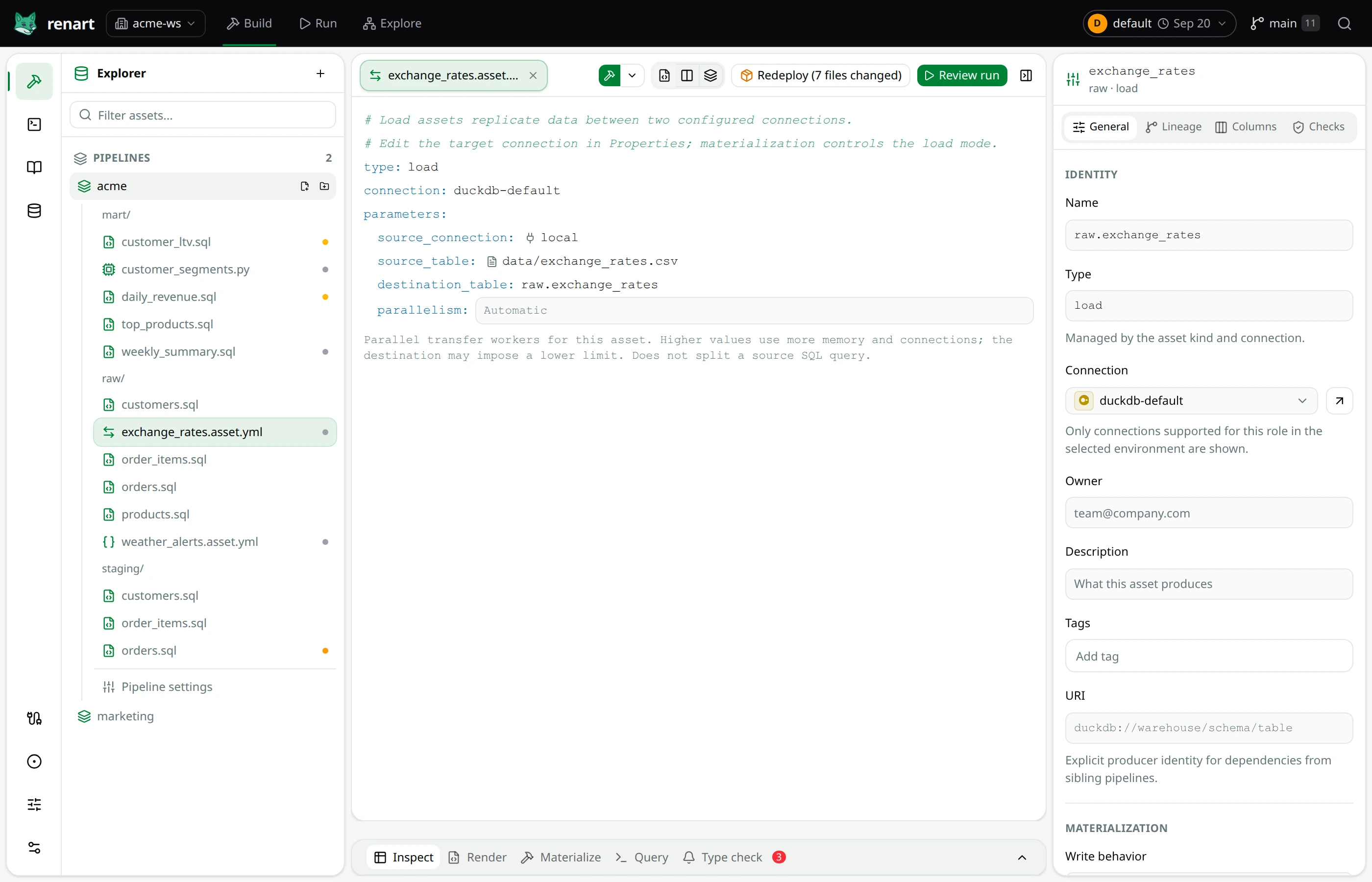
Two kinds of schema feedback.
The feedback you want while authoring a SQL expression is different from handling a new field in incoming data. Renart's editor helps with known names and types during development. dlt's schema inference and contracts address ingestion behavior. Evaluate both needs; one is not a substitute for the other.
Separate dlt from dltHub.
dltHub's documentation distinguishes its open-source library and commercial platform. The latter includes managed runtime and additional transformation, quality and team capabilities. A comparison with the library alone should not be read as a claim that the wider dltHub offering lacks these features.
You do not need to replace a working ingestion pipeline to evaluate Renart. One possible starting point is to work with its output in a supported database, with each workflow's ownership and scheduling kept explicit. This is a pattern to validate for your project, not a native dlt integration or automatic migration.
For a closer comparison between pipeline-development environments, read Renart vs Bruin.
Try the workflow
Start with one local pipeline.
The DuckDB quickstart takes you from installation to inspected results.